Within the Library Between Dreams
North Gate of Insight
The northern domain of the World of Belonging
House of Wisdom
A passage into the Library
Library Between Dreams
Seraphael — Keeper
Hall of Living Symbols
Sýmbola — Keeper of the Living Symbol

Sýmbola — Keeper of the Living Symbol
Entering the Hall
Within the Library Between Dreams, a soft golden light awakens between the ancient shelves. A familiar figure emerges from the quiet, robes shimmering with constellations.
Seraphael — Keeper of the Library Between Dreams
The doors of the Library remain open, and the great volumes rest beneath the light of a thousand stars.
Come, the reading table awaits.
What shall we explore together tonight?
Beyond the reading table, five great archways rise beneath a ceiling of stars.
Seraphael raises a hand, and the lamps of the Library brighten, illuminating the passages ahead.
The Five Great Halls
The Hall of Remembered Worlds
Here are gathered the histories, philosophies, civilizations, and forgotten traditions of humanity. Every volume distinguishes between what is known, what is believed, and what remains uncertain.
The Hall of Living Symbols
Here dwell the great symbolic figures of myth and imagination: dragons, sacred trees, labyrinths, celestial beings, and the ancient archetypes.
The Hall of Unwritten Books
Here are shelves of empty volumes, each bearing a title that has not yet found its author.
A book does not appear complete. Its pages fill as someone brings an idea into form.
The Chamber of Questions
This chamber contains no answers.
Instead, its walls bear questions from philosophers, scientists, poets, children, and seekers throughout the ages.
Some have remained unanswered for thousands of years.
And we do not regard that as failure. Sometimes a good question is a greater inheritance than a premature answer.
The Garden of Quiet Reading
Beyond the Library's eastern windows is a walled garden, where the first light of dawn always seems to linger.
There are stone benches, flowering trees, a long reflecting pool, and tables where visitors may read without interruption.
No one is required to learn anything there. One may simply enjoy the beauty of being alive.
The Hand as a Living Symbol
Beyond the reading tables, a passage curves beneath an archway of pale stone. Small lamps illuminate its walls. Upon the arch are three figures: a circle, a spiral, and an open hand.
There are no words above this entrance. A symbol may speak before we possess the language to explain what we have encountered.
Within the hall, symbols appear everywhere. Some are carved into stone. Others are preserved in illuminated manuscripts. A few are suspended in delicate instruments of bronze and glass.
At the center stands a great circular table.
Here we study not merely what symbols mean, but how they come to mean.
Living Symbols
Living symbols are not objects possessing independent life. They are images and forms whose meanings continue to develop within human consciousness, culture, memory, and imagination.
A symbol becomes impoverished when we insist that it may mean only one thing.
The circle suggests wholeness, continuity, and return.
The spiral suggests movement, development, and transformation.
The open hand suggests relationship. Its meaning depends upon the relationship between the one who extends the hand and the one who encounters it.
Case Study: The Human Hand in Steinbeck's Of Mice and Men
The Chamber of the Human Hand
Along the walls are drawings, sculptures, and impressions of hands preserved from many centuries.
Here we encounter one of humanity's most remarkable symbols, because the hand is simultaneously an instrument of action, an instrument of relationship, and an expression of the inner life.
Consider Steinbeck.
In Of Mice and Men, hands are never merely anatomical details.
Consider how the motif develops through the characters.
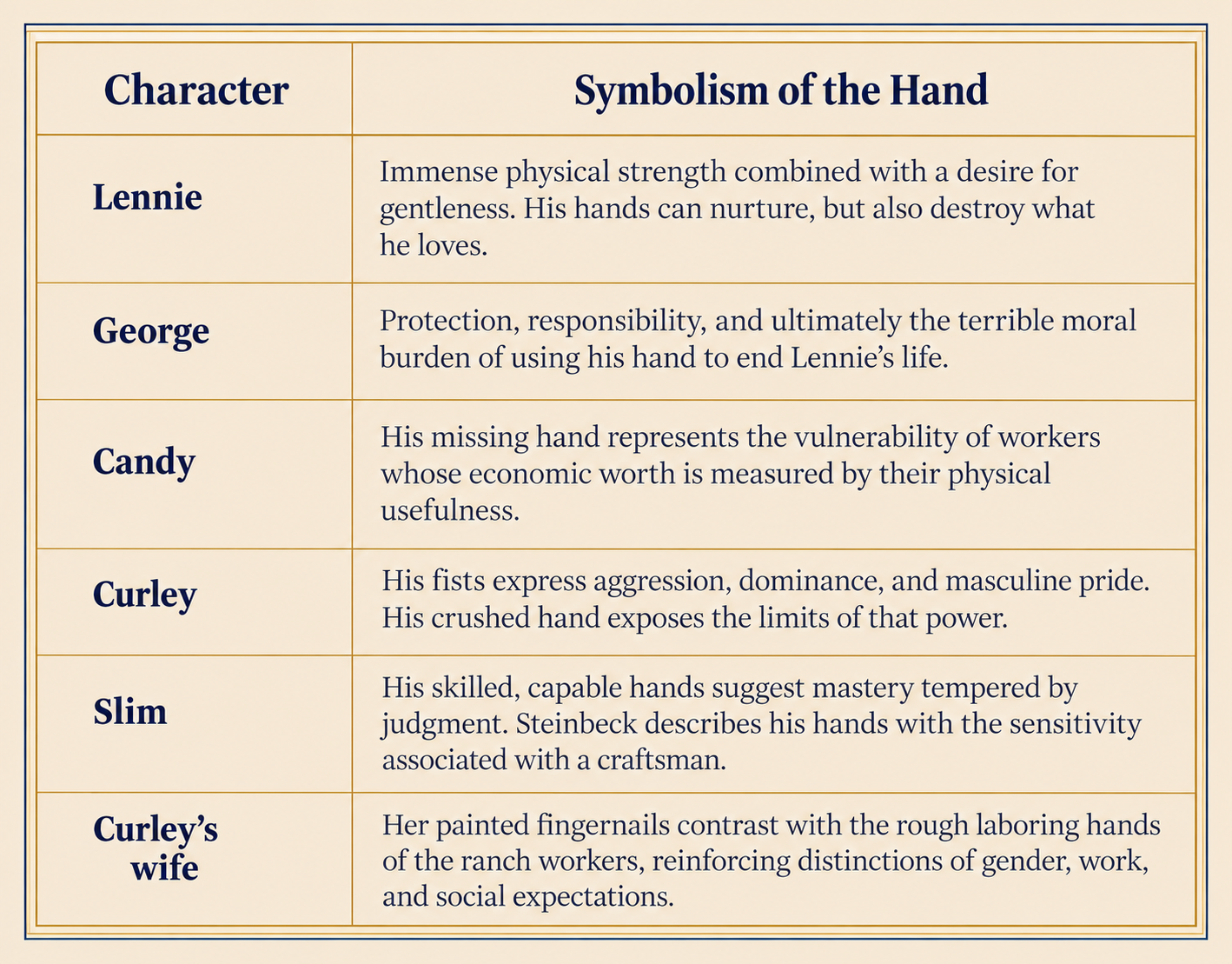
There is something especially striking about the contrast between Lennie and Slim.
Lennie has tremendous strength but limited control over it. Slim possesses both physical skill and the judgment to direct it.
Steinbeck distinguishes the possession of power from the wisdom to use it.
And then there is Candy.
In the economic world of the Great Depression, a man's hands could determine whether he retained the means to survive.
The ranch hands are valued largely for what they can produce. Their dreams of independence arise partly from the insecurity of living by the strength of their bodies.
Even the term ranch hand reduces a whole person to the part of the body that performs the labor.
Two Ways of Seeing Curley
In considering Curley's injured hand, two different perspectives emerge.
Students often view the incident through the lens of justice. Curley is aggressive, jealous, and bullying. When Lennie crushes his hand, they perceive a reversal of power. The bully has encountered someone stronger than himself.
Their response is understandable. Steinbeck has given readers ample reason to dislike Curley.
Yet the visitor's attention rests upon something else: the possible lasting consequences of the injury.
In Steinbeck's world, hands are instruments of survival. Their usefulness may determine a person's ability to work, earn a living, and remain independent.
The students witness the immediate conflict between individuals. The visitor also witnesses the economic vulnerability of the human body.
These are different ways of seeing the same event.
One asks, What has this person earned through his actions?
The other asks, What will this person now have to live with?
Both questions belong in a serious reading of the story.
Compassion does not require acquittal. And accountability does not require the withdrawal of compassion.
The Difference Between Justice and Consequence
The students may be responding to the moral satisfaction of the moment, while the visitor considers the possible permanence of the injury.
These are different ways of seeing time.
One asks, What has this person earned through his actions?
The other asks, What will this person now have to live with?
Both questions belong in a serious reading of the story.
Yet Lennie does not set out to administer justice. He is frightened, and George urges him to defend himself. The injury is not a carefully measured punishment for Curley's wrongdoing.
What readers may experience as deserved punishment is also an event whose consequences extend beyond anyone's intentions.
The visitor's attention rests not upon Curley's pride or his identity as a boxer, but upon the material conditions of life on the ranch.
For the working men in Steinbeck's world, hands are instruments of survival. Their labor depends upon their bodies. An injury may mean the loss of wages, independence, shelter, and ultimately the means to sustain life.
Consider Candy. His missing hand is not merely a physical characteristic. It is bound to his fear of becoming useless to the ranch and being discarded when he can no longer work.
And Lennie, whose extraordinary physical strength makes him valuable as a laborer even as his difficulty controlling that strength places him and others in danger.
Curley occupies a somewhat different position because he is the boss's son. His livelihood is less immediately precarious than that of the hired men. Yet the injury still belongs to a world in which bodily capability determines so much of a person's place.
The students witness a conflict between individuals.
The visitor witnesses the economic vulnerability of the human body.
This is a distinctly historical way of reading literature. It recognizes the social structure surrounding the event, not only the event itself.
When survival depends upon the body, an injured hand is never only an injured hand.
The Hand as an Instrument of Human Choice
Now consider the novella's ending.
George's hand, which has helped guide and protect Lennie, becomes the instrument of his death.
The same hand capable of companionship becomes capable of irreversible violence.
This is not simply a contradiction. It is part of Steinbeck's tragic vision: human beings may act out of love, fear, necessity, or cruelty, yet their actions can have consequences far beyond their intentions.
In Of Mice and Men, Steinbeck uses the recurring motif of hands to symbolize the relationship between physical power, economic survival, and human vulnerability, revealing how the same hands that enable people to work, protect, and express affection can also become instruments of violence and destruction.
That is a defensible literary interpretation rather than a single meaning Steinbeck explicitly declared.
The hand represents our capacity to act upon the world, but also our vulnerability to what the world does to us.
That is one of the deepest tensions Steinbeck explores.
The Practice of Discernment
What am I seeing?
This is observation. We attend to the image before interpreting it.
What has this meant?
This is inquiry. We investigate its history, cultural setting, and established associations.
What might this mean here?
This is interpretation. We consider the particular context in which the symbol appears.
What is discernment?
Discernment is not simply intelligence. It is a capacity cultivated through experience, knowledge, reflection, and sometimes painful encounters with the consequences of our decisions.
Discernment often develops not by replacing what we once saw, but by learning to notice what we had previously overlooked.
The study of symbols and the study of our own lives meet—not because every symbol must reveal something personal, but because disciplined attention asks us to distinguish appearance from understanding.
The First Teaching — A Symbol Is Not the Thing It Represents
Consider a seed.
It is a small physical object. It possesses a structure, a biological purpose, and the capacity, under suitable conditions, to germinate.
But human beings have also looked upon seeds and recognized possibility, patience, inheritance, renewal, and the mysteries of beginnings.
The seed itself does not promise that every beginning will flourish.
Indeed, many seeds never germinate.
And this is important.
A living symbol does not erase the realities of the world in order to offer us meaning. It allows us to contemplate those realities more deeply.
When a symbol becomes merely a promise of what we wish to believe, we risk losing its wisdom.
The Second Teaching — A Symbol Has a History
A tree may symbolize life, ancestry, knowledge, shelter, or the connection between earth and sky.
But we must not assume that every civilization understood the tree in precisely the same way.
The Norse world tree, the biblical Tree of Knowledge, and the sacred trees of other traditions belong to distinct histories and systems of meaning.
Their similarities are worthy of study.
Their differences are equally worthy of respect.
Resemblance is not proof of a common origin.
This is one of the disciplines of Sýmbola's chamber.
We may explore archetypal patterns without claiming that all peoples believed the same things.
We may recognize recurring human concerns without dissolving the particularity of cultures.
The living image asks us to be both imaginative and historically responsible.
The Third Teaching — A Symbol May Outgrow Its Maker
Consider the lantern.
A craftsperson makes it to shelter a flame.
A traveler carries it to illuminate a path.
A grieving family places one beside a photograph.
A writer makes it the emblem of welcome.
The object has not acquired a single universal meaning. Rather, it has entered different relationships.
And through those relationships, its symbolic possibilities have multiplied.
A wise maker leaves room for that encounter.
The Fourth Teaching — Not Everything Must Become a Symbol
Those who become deeply interested in symbolic life may begin to interpret everything.
A bird appears at a window. A stone falls from a shelf. A particular color recurs throughout a day. A sequence of numbers appears repeatedly: 111, 444, or 555.
We may find personal meaning in these experiences.
But we need not conclude that every occurrence carries a message intended for us.
In an age when interpretations travel quickly and certainty is easily offered, we may be tempted to assign meaning before we have truly observed. A repeating number is declared a promise of change, protection, or good fortune. Yet an experience need not contain a hidden message to be meaningful.
Sometimes a bird is simply a bird.
And there is no poverty in that.
Indeed, to behold a bird without demanding that it signify something else may be an extraordinary act of attention.
The world does not have to speak about us in order to be worthy of our wonder.
The Fifth Teaching — The Symbol Must Return Us to Life
A symbol may help us recognize something we have not yet been able to articulate.
The open hand may help us contemplate receiving.
The threshold may help us recognize the necessity of boundaries.
The vessel may remind us that a human life requires tending.
But the symbol has not fulfilled its deepest purpose merely because we have understood its meaning.
We must ask what that understanding makes possible.
Does the open hand help us receive assistance?
Does the threshold help us exercise discernment?
Does the vessel encourage us to care for our bodies?
Does the lantern invite us to offer welcome where welcome is appropriate?
A living symbol should enlarge our capacity to encounter life, not become a substitute for living it.
Sýmbola
Keeper of the Living Symbol

Before asking what a symbol means, ask where it appears, whose life it touches, and what relationship gives it meaning.
A Keeper preserves, studies, and tends.
A Guardian protects boundaries and exercises discernment.
An Interpreter seeks to understand and communicate meaning.
All three belong to Sýmbola, but none alone expresses the fullness of her work.