
King Clovis I
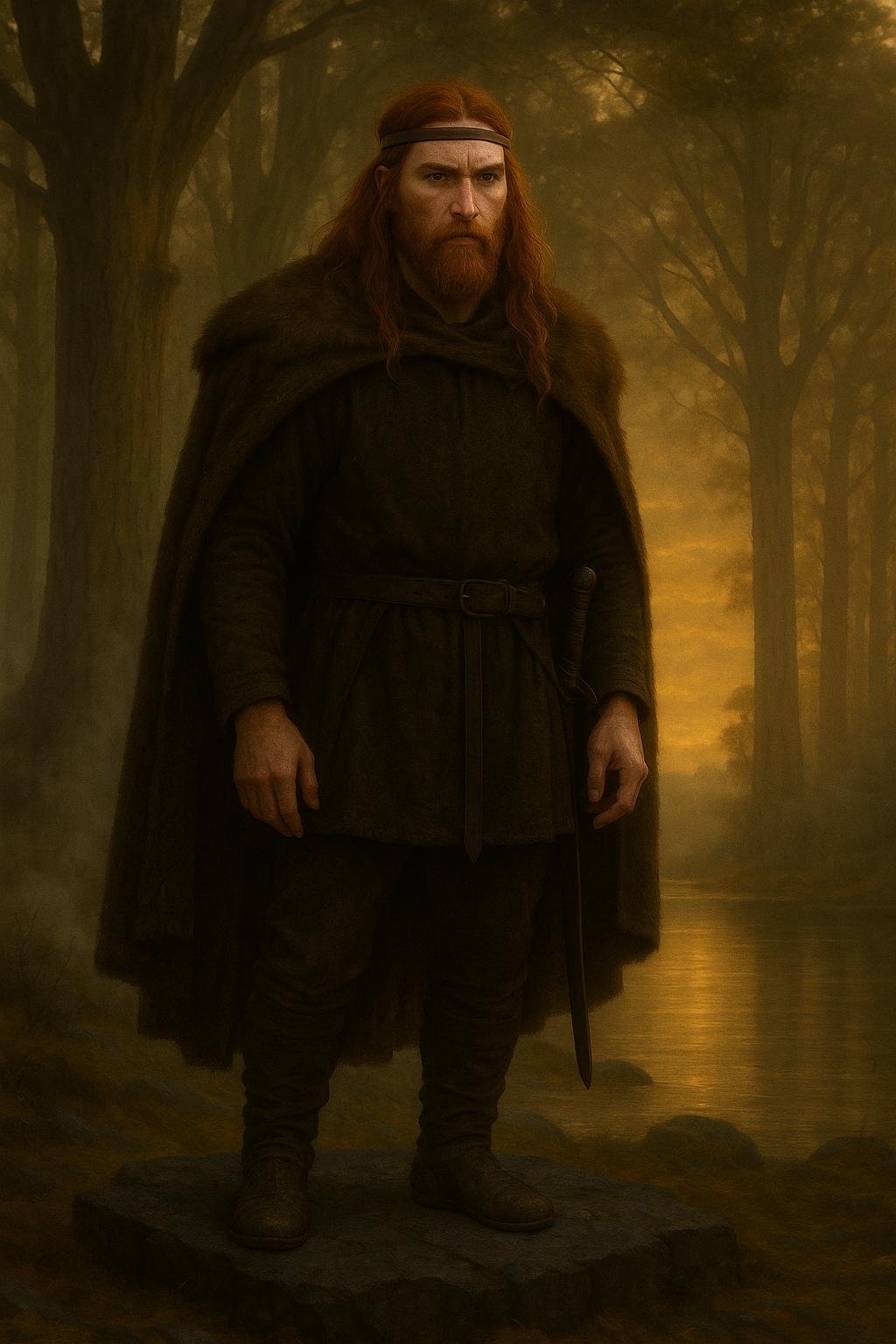
A strong and very close image to what the real King Clovis I looked like.
A presence arrives like the low, resonant toll of a bronze bell at dusk —
not Roman marble, not Byzantine gold,
but the raw, forest-forged power of early Francia.
A king who stood between worlds:
pagan warlord and Christian sovereign,
warrior and bridge-builder,
thunder and baptismal light.
King Clovis I carries the grounded weight of an oak grown around storms.
Fur-lined cloak. Iron circlet. Wolf-grey eyes that miss nothing.
Behind him, the faint echo of battle standards,
and the quiet rush of the River Marne
where he stepped into the water and emerged into destiny.
He is the hinge between an old life and a new one,
the moment when a path breaks open.
He is the break of dawn.
He is the flint —
the spark that ignites.
Clovis was fifteen when power fell upon his shoulders.
An unsheltered Merovingian child trained to ride, fight, listen, negotiate,
and—above all—command.
He became king because someone had to hold the tribes together.
He says, quietly:
“A kingdom cannot rise on negotiation alone.
It must rise on stability.”
And he was that stability.
THE OLD WAYS AND THE NEW PATH
He grew within paganism, and he speaks of it without shame:
“Our paganism was not wicked.
It was simply old —
a way of understanding life before books,
before councils,
before laws.”
He names the five pillars of that world:
The land is alive.
Treat it well, and it treats you well.Spirits dwell in places.
Rivers, groves, stones, storms, animals.Ancestral presence matters.
The dead watch to guide, not judge.Ritual gives meaning to survival.
Every oath, every hunt, every harvest had ceremony.Humans and nature are not separate.
We were part of the living world, not its masters.
“Our old ways taught reverence — not fear.”
But the clans were divided.
Each family stood alone.
The new faith united them as one people.
Clovis chose what would hold them together.
He offered protection, fairness, and shared victory.
And so Francia rose — not by accident, but by unification.
Recognized by the Byzantine Emperor Anastasius I,
Clovis became a bridge between the fading empire
and the forming kingdoms of Europe.
He is a turning point in history,
a threshold through which nations passed.
THE TURNING-POINT PRESENCE
King Clovis is a Turning-Point Presence in the World of Belonging:
He is direction.
He is the moment scattered paths become a single road.
The moment survival becomes structure.
The spark of decision.
The first light before dawn.
Clovis’s gift to the seeker is the path forward.
He brings:
clarity at crossroads
direction when all options feel the same
grounded leadership
courage to unify fractured parts of life
the strength to choose without fear
stability after wandering
a map where there had only been instinct
His presence in your life means only one message:
“The turning is here.”
