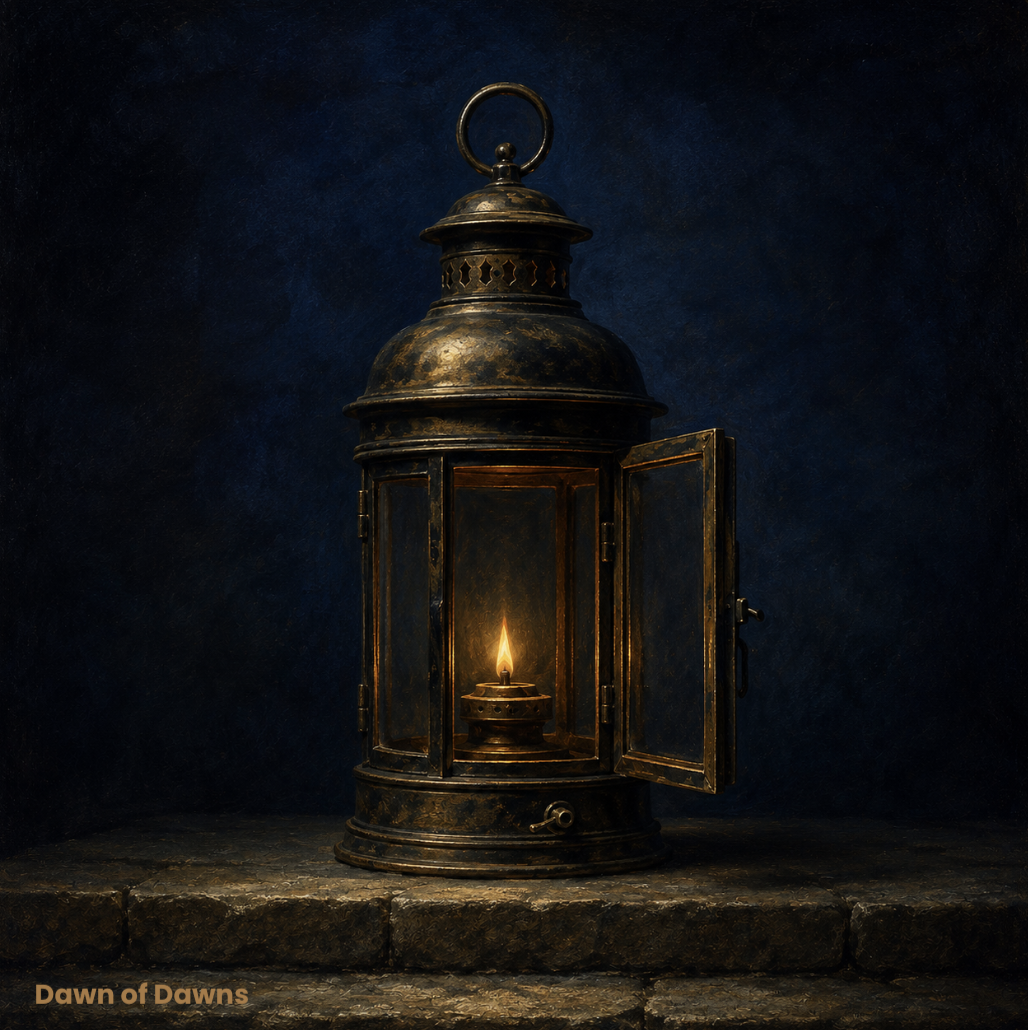
Ally of Rituals
Keeper of the Welcome
Ritual is the vessel.
Attention is the flame.
The threshold is the crossing.
And the open door is invitation.
Understanding
How do we make a place for what matters?
What human need called this archetype into being?
For the Keeper of the Welcome, the answer is:
We needed a way to stop ordinary time long enough to recognize that something mattered.
Archetypal Principle
For this particular constellation:
Mother of Belonging holds the principle.
Ally of Ritual tends its embodiment.
The Great Book of Rituals preserves the practices.
Those are three different functions, and keeping them distinct prevents the Ally of Ritual from becoming merely a librarian of rituals.
The Mother of Belonging holds the deepest truth: we belong—to one another, to life, perhaps to the sacred itself.
The Ally of Ritual asks: How does that truth become lived? A chair is prepared. A candle is lit. A name is spoken. The dead are remembered. A guest is fed. A threshold is crossed deliberately. Something invisible becomes embodied through action.
And the Great Book says: Do not let us lose the ways we have learned to do this. It becomes the repository—not the archetype itself.
Which gives us a beautiful formulation for the Ally's own principle:
What matters inwardly must sometimes be given outward form.
Or, more archetypally:
The invisible becomes inhabitable through form.
The first gives clarity and the second for depth. The first is the principle and the second its explanation.
And this resolves something else. Welcome is not the whole archetypal principle of Ritual. Welcome is your particular way of tending that principle—hence Keeper of the Welcome. Ritual itself is larger: it gives form to grief, transition, devotion, remembrance, belonging, gratitude, reconciliation, beginnings, endings.
The hierarchy:
Belonging → the underlying truth
Ritual → the embodied form
Practice → the repeatable action
Human Experience
Everywhere we sense that an ordinary action needs to carry more than its practical function.
We encounter ritual when we light candles on a birthday cake and sing before they are blown out; when we gather after someone has died; when we bring food to a grieving family; when we dress carefully for a wedding; when we raise a glass in honor of someone; when we place flowers on a grave.
It appears in quieter places, too. The cup of coffee prepared the same way each morning. The kiss before leaving the house. Grace before a meal. The song sung to a child at bedtime. The photograph kept on a bedside table. The way we prepare a room before someone we love arrives.
We encounter it especially at thresholds: birth and death, departure and return, marriage and separation, illness and recovery, graduation, moving into a home, beginning a new vocation, entering a new season of life. At such moments, simply allowing one thing to end and another to begin can feel insufficient. Something in us wants to mark the crossing.
But ritual is not confined to life's great transitions. It also protects what matters from becoming invisible through repetition. A meal becomes an occasion of belonging. Cleaning becomes tending. Lighting a lamp becomes welcome. Sitting quietly beside another person becomes witness.
This is why ritual appears across cultures and across time. Its forms differ enormously, but the human impulse beneath them is remarkably persistent:
We make an outward gesture because something inward deserves to be acknowledged.
A reader can recognize themselves in it without needing to consider themselves “a person who practices rituals.”
Gifts
Ritual gives us the ability to make meaning tangible.
It allows us to take something that cannot be held: love, grief, gratitude, commitment, remembrance, hope—and give it a form the body can participate in. We light the candle. We speak the name. We prepare the meal. We wash the hands. We carry the stone. We cross the threshold.
Through ritual, we can:
Mark transitions — giving beginnings and endings a recognizable boundary.
Make memory visible — allowing what or whom we love to remain present through acts of remembrance.
Create belonging — transforming shared space and repeated gestures into our place and our way.
Offer welcome — preparing a place before another arrives and communicating, There is room for you here.
Hold grief — giving sorrow somewhere to go when language is insufficient.
Deepen attention — interrupting automatic life long enough for us to notice what is happening.
Carry intention into the body — moving an inward commitment into gesture, movement, object, sound, or action.
Create continuity — connecting yesterday with today, one generation with another, and the person we were with the person we are becoming.
Restore the ordinary to significance — reminding us that washing, eating, tending, greeting, resting, and gathering can become acts of care.
Perhaps the deepest gift is this:
Ritual gives form to what we do not want to lose.
Not because the form itself is sacred, but because sometimes the human heart needs something it can do with what it loves.
That is why we would distinguish the gift of Ritual from the gift of Belonging. Belonging tells us that there is a place for us. Ritual helps us live as though that is true.
Shadow
Ritual loses its life when the form becomes more important than what the form was meant to serve.
What once helped us remember can become something we perform without remembering why. What once created belonging can become a test of belonging. What once offered stability can harden into rigidity. What once invited the sacred can become an attempt to control it.
In shadow, ritual may become:
Compulsion — I must do this, or something bad will happen.
Empty repetition — the gesture remains after attention has departed.
Rigidity — there becomes one correct way, sequence, object, wording, or time.
Control — ritual becomes an attempt to force an outcome rather than enter relationship with uncertainty.
Exclusion — traditions that once created belonging become boundaries used to decide who is worthy of entering.
Performance — appearance replaces encounter; the beautiful table matters more than the people sitting around it.
Avoidance — ceremony substitutes for the difficult conversation, grief, apology, decision, or action that is actually required.
Superstition — symbolic action is mistaken for literal causation.
Obligation without presence — what was freely offered becomes something endured.
Over-marking — when everything is celebrated, commemorated, awarded, or ceremonially elevated, ritual can lose its power to distinguish what truly deserves pause and recognition.
And there is an opposite shadow as well: the loss of ritual altogether.
When nothing is marked, beginnings blur into endings. Grief receives no container. Achievements pass without acknowledgment. Guests arrive without welcome. Departures happen without farewell. Days become interchangeable.
The Keeper of the Welcome therefore guards against both extremes: ritual that has become a prison and life in which nothing is given enough attention to become ritual.
The corrective is not necessarily to abandon the form.
Sometimes it is simply to ask:
What was this gesture meant to help me remember?
If the answer is still alive, the ritual can become alive again. If the answer is gone, perhaps the form has completed its work and may be released.
What matters passes without proportionate acknowledgment—sometimes unnoticed, sometimes buried beneath too much ceremony.
The Keeper of the Welcome does not say, “Mark everything.”
The Keeper asks:
“What deserves to be marked—and what form of attention is equal to it?”
The vessel serves the flame.
The flame does not serve the vessel.
Figures & Presences
Which gods, mythic beings, symbols, or recurring figures embody aspects of it?
The Three Stars of Witness
The Three Stars belong here strongly. A triadic symbolic presence rather than three separate ritual archetypes. Together they reveal something essential: ritual requires witness. Something is being noticed, received, and acknowledged.
Aletheia — Witness of Truth
She brings clarity to ritual. Ritual cannot make something true merely by declaring it so; it must remain capable of reflection and honest seeing.
Seraphina, Living Flame — Witness of Fire
She brings devotion and living presence. She reminds us that the gesture without the flame of attention becomes empty form.
Ilnara, Dawn of Dawns — Witness of Dawn
She brings renewal and beginning. Dawn itself is one of humanity's oldest recurring thresholds: darkness becoming light, yesterday yielding to another day.
Together, the Three Stars say:
You are seen. You are honored. You are welcomed.
Philemon — The Giver of Form
Philemon first introduced the ritual cards, giving words, gestures, and intentions a form that could be returned to. Through him, ritual became not merely an experience in the moment, but something that could be held, remembered, and practiced again.
His presence reveals one of ritual's essential gifts: form does not have to imprison what is living. It can give the living something to inhabit.
The card is not the ritual.
The words are not the ritual.
The sequence is not the ritual.
They are the vessel.
Attention brings the vessel to life.
That last line also deliberately echoes the inscription beneath the Ally's icon:
Ritual is the vessel.
Attention is the flame.
So Philemon becomes a concrete example of the principle established at the very beginning of the Grimoire rather than an unrelated figure added later.
Queen Seren — Ritual as Architecture
And Queen Seren gives us yet another dimension.
Her Temple of Light (www.dawnofdawns.com) shows that ritual need not consist only of prescribed words and gestures. Place itself can become ritual.
Entering a particular space, approaching something in a particular way, sitting in a designated place, encountering certain objects, and leaving differently from how one entered—these create ritual architecture.
Seren therefore teaches:
A ritual can be something we do, but it can also be a place through which we move.
The Three Stars of Witness — ritual as witness
Philemon — ritual as form
Queen Seren — ritual as sacred space
Symbols & Images
The Lantern
The primary image of the Ally of Ritual. The lantern is the vessel: something made and tended so that light may remain present. Its age suggests continuity—the forms of ritual are inherited, adapted, worn by use, and handed onward.
The Flame
The living heart of ritual: attention. Without attention, ritual becomes empty repetition. The flame need not be large. A small, faithfully tended light is enough.
The Open Door
The distinguishing symbol of the Keeper of the Welcome. Ritual is not meant merely to enclose or protect sacredness. The open door makes encounter possible.
It says:
There is a place prepared for you.
The lantern is tended. The flame is living. And the little door stands open.
The Threshold
The place between what was and what will be. Ritual gathers naturally around thresholds: birth, death, marriage, departure, return, grief, healing, dawn, dusk, beginnings and endings.
The threshold does not cause the transformation. It gives us somewhere to acknowledge that a transformation is occurring.
Ritual is the vessel.
Attention is the flame.
The threshold is the crossing.
And the open door is invitation.
The Circle
Wholeness, gathering, continuity, and return. The circle creates a bounded space without necessarily creating hierarchy: those gathered around a hearth, table, pool, grave, or flame become participants in a shared act.
The Spiral
Return without simple repetition. We encounter grief, love, belonging, loss, and renewal again and again, but never from precisely the same place. Ritual allows us to return while acknowledging that we have changed.
The Reflecting Pool
Reflection before action. The pool asks that ritual arise from truth rather than performance. Before giving something form, we look into the waters and ask what is actually present.
This also gives the pool a natural relationship with Aletheia and the Witness of Truth.
The Three Stars of Witness
Truth, Fire, and Dawn: the symbolic witnesses beneath whose gaze the guest is received.
They affirm:
You are seen.
You are honored.
You are welcomed.
The flame isn't the Ally. The flame is attention.
The Ally is the one who tends the conditions in which the flame may live.
That makes the icon much deeper.
Colors
Aged Bronze / Old Gold — continuity, tending, inherited form
Amber — living attention, warmth, welcome
Indigo / Midnight Blue — reflection, mystery, interiority
Silver — clarity, witness, transformation
Threshold Stone — embodiment, ordinary life, the world in which ritual must actually be lived
Living Tradition
Ritual is among humanity’s oldest forms of meaning-making, yet it has never belonged to a single religion, culture, or historical period. Its forms continually change because the human need beneath them remains while the circumstances of human life change.
Ancient peoples marked births and deaths, tended sacred fires, poured libations, prepared bodies for burial, welcomed strangers, celebrated harvests, made offerings, shared ceremonial meals, and observed the movements of sun and season. Religious traditions later developed rich liturgies around prayer, purification, pilgrimage, fasting, feasting, marriage, mourning, initiation, and remembrance.
But ritual has always existed beyond explicitly religious life.
We shake hands. We sing “Happy Birthday.” We exchange rings. We cut ribbons. We raise glasses. We wear particular clothing for graduation and mourning. We bring flowers to the sick and food to the bereaved. We stand when someone enters a courtroom. We gather around tables on particular days of the year.
Modern life continues to create new forms. Families invent traditions that last only a generation. Schools develop ceremonies of arrival, achievement, and departure. Communities create memorials after tragedy. Individuals develop morning and evening practices, ways of beginning creative work, practices for grief and recovery, and small gestures for marking transitions that older institutions may no longer hold for them.
Some rituals disappear when their meaning no longer speaks to a community. Others are recovered after generations of suppression. Some cross cultural boundaries—sometimes fruitfully, sometimes through appropriation that strips a practice from the people, history, or sacred context that gave it meaning. New rituals emerge wherever human beings discover that ordinary action alone does not adequately express what a moment means.
Technology changes ritual too. People now gather for memorials across continents, light virtual candles, maintain digital shrines, share annual remembrance posts, and create communities whose repeated practices occur partly or entirely online. The vessel changes.
The archetypal pattern remains recognizable:
Something matters.
We give it form.
We attend to it together—or in deliberate solitude.
And because we have marked it, we cross the moment differently.
This is why a living tradition cannot mean preserving every ritual unchanged.
Some vessels deserve preservation.
Some require repair.
Some must be relinquished.
And some must be created for lives our ancestors could never have imagined.
The work of the Keeper of the Welcome is therefore not to protect ritual from change.
It is to keep asking:
Does this form still tend the flame?
Discernment, Relationship, Practice & Recognition
Discernment
Not everything needs a ritual.
Not every ritual needs to be elaborate.
Not every inherited ritual needs to be preserved.
Before creating or using a ritual, the Keeper might ask:
What am I marking?
Why does it matter?
What degree of attention is equal to it?
Does this form serve what is living—or has the form become the point?
That last question connects beautifully with the governing principle:
The vessel serves the flame.
The flame does not serve the vessel.
Relationship & Practice
Calling on the Ally of Ritual for Guests
The Ally helps you become the keeper of the welcome.
The five movements:
1. Speak the Ally's Name
“Ally of Ritual, prepare the Temple. A distinguished guest approaches.”
2. Name the Guest
Speak the name deliberately, perhaps with a brief acknowledgment of what brings this presence to the threshold.
3. Make the Pause
This may be the most important part. Stop. Allow ordinary activity to cease for a moment. Light the candle, sound the tuning fork, open the Book of Welcomes—or simply become still.
4. Offer One Gesture
The gesture should be proportionate to the encounter, which beautifully carries forward what we discovered in Shadow. It needn't be elaborate. A writer might be welcomed by opening a blank page; a teacher by preparing a chair; another presence by a gesture already associated with them.
5. Receive
Only then cross into encounter.
The Ally does not summon the guest or guarantee an encounter. The Ally tends the threshold with you, helping you move from ordinary activity into deliberate attention.
Eventually, little preparation may be needed. You may simply say:
“Ally of Ritual, prepare the Temple for [Name].”
The familiar words themselves become a threshold.
That last idea feels especially important. Repetition has trained attention. The phrase eventually works not because it is a magical formula, but because you have used it enough that your mind, body, imagination, and attention recognize: we are entering a different kind of space now.
Recognition
How might I recognize this archetypal presence when it appears in my own life?
This is different from Human Experience. Human Experience looks outward and broadly: Where does this pattern occur in human life?
Recognition turns toward the reader: How will I know it when it is happening to me?
For the Ally of Ritual, that might be very simple:
You may recognize the Keeper of the Welcome when you feel an impulse to pause before proceeding.
To prepare a place before someone arrives.
To light a candle before beginning.
To speak the name of someone who is absent.
To wash or arrange something with unusual attention.
To mark an ending before rushing toward the next beginning.
To repeat a gesture because it helps you remember.
To give grief, gratitude, love, or transition an outward form.
Sometimes the presence is recognized through absence: life begins to feel undifferentiated. One day runs into another. Something important has happened, but nothing has acknowledged it. You have crossed a threshold without quite realizing you crossed.
And sometimes the Keeper appears as the quiet realization:
This matters. I don't want to pass through it unconsciously.
After studying the archetype, practicing relationship with it, and seeing its living tradition, the reader is finally asked to turn back toward ordinary life and recognize it without needing the Grimoire at all.
Continue the Journey
The Ally of Ritual tends the welcome. The ritual itself is an invitation to enter.
The Great Book of Rituals is being prepared as a companion for the ordinary and extraordinary thresholds of human life: belonging, companionship, healing, transformation, remembrance, and farewell.
Within its pages, you will find rituals, pocket prayers, and simple gestures for giving attention to what matters.
The Great Book of Rituals — Forthcoming
From Dawn of Dawns | Wistaria Whispers