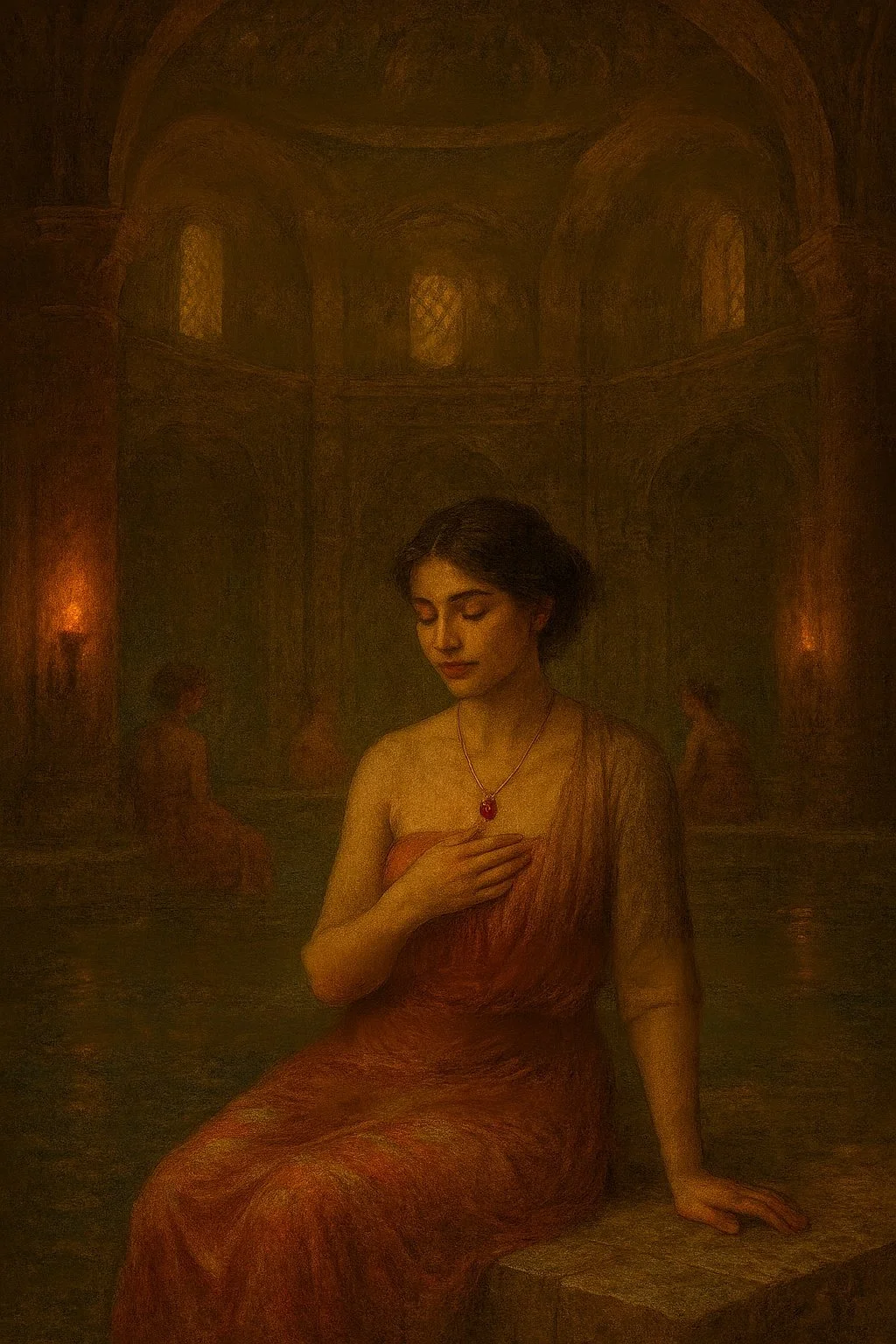
Suleiman the Magnificent and Haseki Sultan (Roxelana)

“A ruler who cannot appreciate beauty will always govern with fear.
A ruler who understands beauty may govern with calm.” —Suleiman the Magnificent
In the World of Belonging, a sovereign of golden order steps forward. Suleiman the Magnificent enters the Byzantine Dawn temple with the calm of a well-governed empire and the quiet brilliance of a steady sun.
Suleiman the Magnificent
Suleiman the Magnificent lived in the golden age of the Ottoman Empire and ruled not by impulse, but by law. He was a loving husband and father; a poet writing under the name Muhibbî; a master craftsman; a devout seeker of the Divine; an architect of cities and systems; a warrior who accepted responsibility for his people; and an emperor who governed with clarity, not whim.
His reign brought stability, coherent legal codes, flourishing architecture, charity complexes, economic regulation, protection of the poor, and a golden age of arts and learning. His people called him Suleiman the Magnificent because he served with order.
“A people love a ruler who brings calm to their days,” he says. And this was his gift: calm order, dignified structure, and golden clarity.
In the Dawn realms he stands within the Solar Lineage — a bearer of radiant balance, a sovereign whose light brings structure without severity and grace without weakness.
Hürrem Sultan, The Ruby-Golden Heart
A deeply warm and unhurried presence arrived shortly after Suleiman the Magnificent—his beloved wife, Hürrem, of the Ruby-Golden Heart lineage of devotion and fire.
In her lifetime, Hürrem entered the palace as a young woman, first a captive, then a servant, then a concubine in the imperial household. Yet something in her dignity, intelligence, and radiant warmth surprised even the Sultan.
Against all precedent, their hearts chose each other—in respect, in affection, in sovereign love. Hürrem became his chosen wife, Haseki Sultan—a title never before given to a woman in the Ottoman world.
The Poem of “Muhibbî”
They shared many poems, but the one they cherished most was this quiet, truthful one written by Suleiman under his pen name Muhibbî:
**“The people think wealth brings happiness.
They do not know that happiness is the heart.
If the heart is content,
the world is yours.
If the heart is restless,
even a throne cannot bring peace.
Riches are not gold nor silver,
but a loyal heart beside you.
Paradise is not a garden beyond the world—
Paradise is the face of the one you love.”**
The Sovereign Heart
Because Hürrem was both worthy and trusted, the Sultan granted her financial autonomy and political authority. She shaped the inner world of the palace—bringing refinement, literacy, education, and cultural patronage: music, poetry, art, and women’s correspondence.
She wrote to foreign rulers, supported charitable institutions, and advocated for widows, travelers, and the poor. Her legacy includes the Haseki Sultan Complex—a mosque, school, hospital, kitchen, and social center; fountains, endowments, and educational institutions; and the Haseki Hürrem Sultan Bathhouse across from the Hagia Sophia.
Her Transformation
Hürrem rose from slavery to the Sovereign Heart—not through ruthlessness, but through resilience, devotion, and radiant intelligence.
She transformed suffering into purpose, constraint into compassion, and power into generosity.
Hürrem’s life is a testimony to the ember that survives and rises.