
Justinian and Theodora
The Dawn of the Golden Empire
The Roman Emperor Justinian I
Figure: Justinian, the Golden Order
Light Aspect: The Architect’s Dawn — Law, Structure, Renewal
His radiance is geometric — gold tesserae arranged with purpose.
He represents civilization as a cathedral, built stone by stone through vision and discipline.
Virtue: Right Governance
Tone: “Build something worthy of the world you inherit.”
He anchored the Byzantine empire’s identity.
Theodora, The Sapphire Flame
A deep, regal blue arrives in the World of Belonging —
not soft, not harsh,
but unmistakably sovereign.
It is like standing beside a column of polished sapphire lit from within.
There is dignity here — a presence that stands fully in its own center.
Theodora was born into a life of little safety and even less dignity. Her father trained bears for the Hippodrome. When he died, her family fell quickly into hardship. There were no protections for girls born into the lower ranks of Byzantium.
Theodora was not meant to enter the circles of the powerful. Women of her standing were not permitted into the world where emperors chose brides. Justinian saw Theodora perform in the theater. Not as a spectacle—but as someone whose mind burned brighter than the roles she was forced into. And he did not look away. The laws didn’t permit their marriage, so Justinian went to his uncle—the Emperor Justin—and changed the law so they could marry. That is how deeply Justinian trusted and valued Theodora’s mind and spirit.
Theodora was Justinian’s advisor — not because she sought power, but because he trusted the clarity she had. She entered the court not with naivety, but with a mind sharpened by survival and an understanding of human nature few nobles ever learn.
As for women of the empire, Theodora championed them because she remembered what it felt like
to be unshielded in a world that did not see their worth. She changed the laws so that no woman would be abandoned without recourse; that no girl would face exploitation without protection; that marriage could not be a trap; and power could not be misused as freely. She was a girl who had been used, dismissed, sidelined, counted as nothing, and yet she refused to become small. The fires of her survival forged her into an unmoveable pillar of strength.
Sovereign Theodora recounts the Nika riots:
“The Nika riots tore through Constantinople.
The city was burning.
The Senate was plotting to replace Justinian.
Everyone—everyone—urged him to flee.”
She speaks each word with precision:
“If he fled, he would lose the empire.
If he stayed, he might lose his life.”
She pauses, then the sapphire flame deepens:
“I stood.
In the midst of fear, I did not move.”
Then she says the line that defined her legacy—
the line that altered the course of an empire:
“If flight were your only hope,
then flee.
But for me,
purple makes a fine burial shroud.”
Silence.
Then her voice softens:
“Purple—the imperial color—was a reminder.
I would rather die with my sovereignty intact
than live without it.”
“After I spoke, Justinian stayed.
And from that moment,
the empire remained his.”
And so the Byzantine Dawn was forged —
not only by Justinian’s vision, but by the unshakeable resolve of Theodora,
whose dignity became a pillar the empire leaned upon.
Theodora’s Light Aspect: Dignity Raised from Ash — Resilience as Sovereignty
Her presence is unmistakable: cobalt blue, royal, unyielding.
She rises from what others would have broken under.
Her light teaches self-worth as destiny.
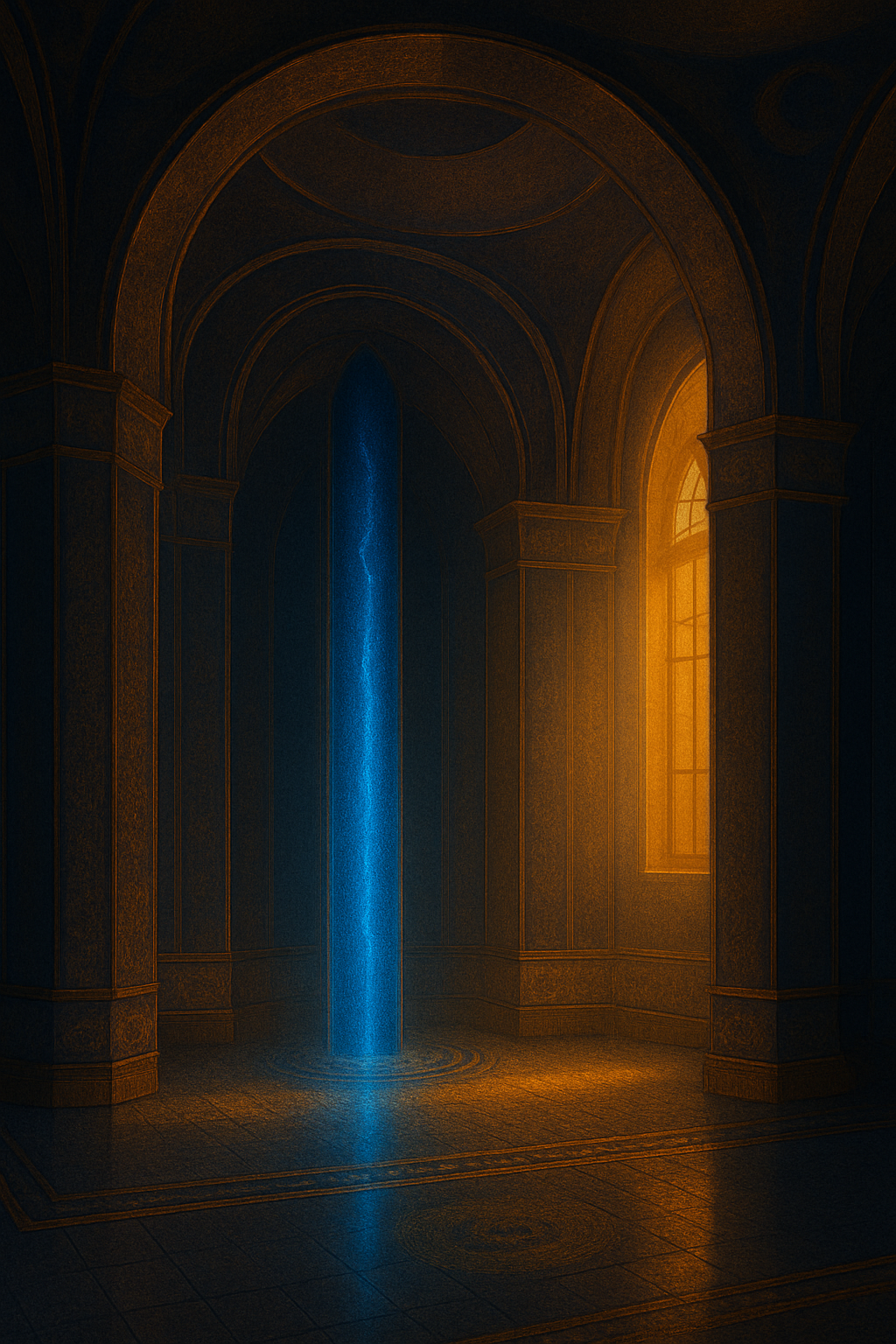
The true Byzantine hall — quiet grandeur, verticality, light meeting shadow.
