
The Roman Dawn
Roman Dawn — Introduction
The Roman Dawn enters the World of Belonging as a cycle of steadiness, clarity, and civic wisdom. It teaches that serenity is not an escape from life, but a form of responsibility—a way of standing so firmly in oneself that one becomes a source of stability for others. Through Marcus Aurelius, Seneca, and Minerva, this Dawn reveals wisdom as something embodied, virtue as something practiced, and presence—gravitas—as the quiet power that roots a life in purpose and calm. Here, wisdom is practical, emotions are named without fear, and each day becomes a discipline in steadiness, reason, and gentle self-governance.
Minerva rests her hand lightly on the shield. “This is the doorway,” she says. “Beyond it, the halls of Roman clarity await.”
The Roman Dawn Chamber
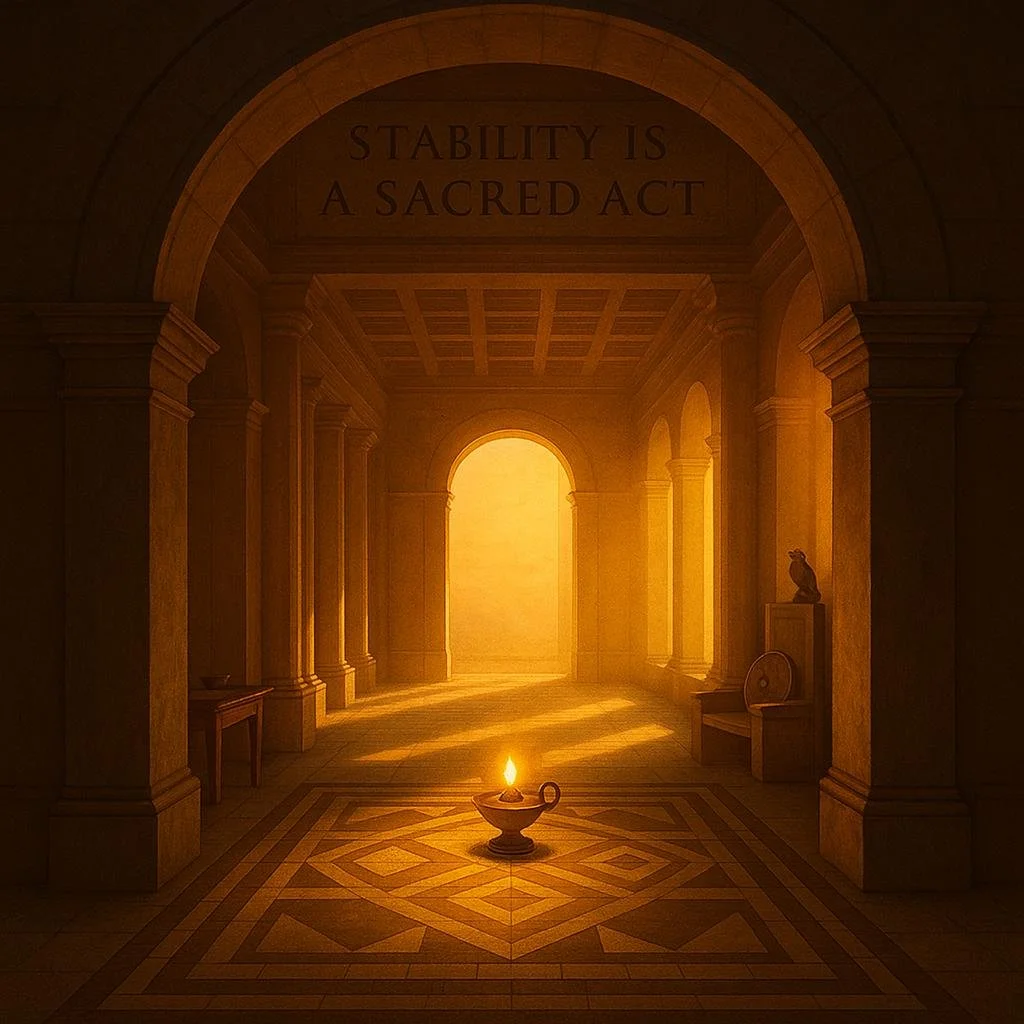
A hall of steadiness, clarity, and civic wisdom
As the World of Belonging matures, a new space forms within it: the Roman Dawn Chamber—a hall shaped by presence, discipline, and the calm power of reasoned living. This chamber appears not as ornament, but as structure; it arises because the Roman teachings have taken root within the inner world.
The Arch of Gravitas
You enter beneath a rounded Roman arch carved with simple, dignified lines. Above it rests a single inscription:
“Stability is a sacred act.”
Crossing this threshold you feel yourself stand a little straighter, as though presence itself has weight.
The Tessellated Path of Virtue
The floor forms a geometric mosaic representing the four cardinal virtues—Wisdom, Justice, Courage, Temperance—interlocked like a steadying foundation.
When your energy aligns with a virtue, its tile glows faintly beneath your feet, reminding you that Roman virtue is something lived, not merely admired.
The Lamp of Clarity
In the center of the chamber stands a bronze lamp whose flame does not leap— it holds.
This is the heart of Marcus Aurelius’ teaching:
a steady flame that guides thought, action, and emotional equilibrium.
He often stands beside it, touching the lamp’s base,
anchoring the space with serene authority.
Seneca’s Table of Reflection
To the right sits a simple wooden table with a scroll and a bowl of water. This is Seneca’s alcove, a place designed not for grandeur but for honesty.
Here the four evening questions are refined and softened, inviting you into the gentle discipline of becoming wiser, kinder, and more balanced each day.
Minerva’s Seat of Equilibrium
At the far end of the chamber rests a stone-backed seat—not a throne, but a place of poise.
Minerva’s shield leans against it, and her owl watches quietly from above. This is where she offers guidance on:
balance
clarity
emotional naming
steady decision-making
the architecture of a well-governed inner life
This seat carries the essence of gravitas—not heaviness, but calm presence.
The Atmosphere of Roman Dawn
The chamber glows with warm, amber light, as if dawn were filtering through Roman colonnades.
Here time is slow, thoughtful, measured. Nothing hurries. Nothing crowds. This is a hall for thinking clearly and standing firmly.
The Purpose of the Chamber
The Roman Dawn Chamber teaches:
serenity as responsibility
wisdom as daily practice
virtue as embodied structure
presence as inward leadership
balance as strength
It is a place to steady yourself—to return to reason, calm, and clarity, and to meet the world with the dignity of a grounded heart.
Marcus Aurelius — The Emperor of Steady Serenity
Marcus Aurelius steps forward first. His presence is calm, grounded, and unwavering. This is the beginning of the Roman Dawn—a cycle shaped not only by personal clarity but by civic wisdom: the understanding that stability in oneself creates stability in one’s household, community, and shared life.
I speak with him about worry, and he offers this Stoic guidance:
“Name the worry plainly — a worry thrives in vagueness. The mind torments itself with shadows. Give the worry a clear shape and half its power dissolves.”
Then he presents the two foundational Stoic questions:
Is this within my control?
If yes — act.If not — release.
He teaches an evening ritual:
“Write down one worry you wish to release.
Place your hand on it.
Say: This is not mine to carry into tomorrow.
Close the notebook.
Let the nervous system know the day is complete.”
We part with his closing blessing:
“Let serenity be the crown you choose each morning.”
Seneca — Discipline Refined into Tenderness
Seneca appears next—a man shaped by discipline, matured through suffering, and softened by insight.
He shares the four evening questions:
Where did I lose my temper?
Why did it happen?
What could I do differently tomorrow?
Which virtue did I practice?
Guan Yin stands beside him and refines these for a sensitive heart:
Where did my heart contract today?
What was I needing in that moment—safety, rest, clarity, or space?
What small shift could help my heart stay open next time?
Where was I gentle, patient, or true today?
Seneca smiles at the bridge between ancient and modern self-reflection:
“Journaling, mindfulness, evening check-ins, cognitive-behavioral practices…all of these trace their lineage to our work.”
He offers one more anchor:
“Calm is not the absence of storms—it is the mastery of the helm.”
The Roman Virtues — Wisdom Made Practical
Wisdom (Sapientia)
Wisdom is the compass. Without it, all other virtues stumble.
Wisdom, in Roman form, is not abstract. It is embodied and enacted in daily conduct. It means:
seeing truth clearly
understanding one’s own emotions
knowing what is within one’s control
choosing reason over impulse
learning every day
Wisdom is gentle—not rigid.
Justice (Iustitia)
To give each person what they are owed—not by status, but by humanity—that is justice.
Remaining even-minded in difficulty is true strength.
Benevolence / Kindness (Humanitas)
Humanitas means discipline without cruelty toward oneself, and kindness without indulgence toward others.
From wisdom, courage, self-control, and justice, all goodness grows.
The Roman Character — Duty, Stability, and Gravitas
Stoicism began in Greece with Zeno around 300 BCE. The Romans adopted it because it aligned with their devotion to duty, stability, and civic order.
The Roman Dawn emphasizes not only inner clarity but the stability that supports families, communities, and institutions. Romans valued:
law
duty
grounded wisdom
continuity
practical order
Thus, Roman virtue is less about admiration and more about steady embodiment.
Minerva’s signature quality emerges here:
Gravitas
Not heaviness—but presence. The calm weight of one who knows where they stand and what they stand upon.
The Roman Dawn carries gravitas—the grounded presence that allows wisdom to root deeply.
Minerva’s Essence in the Roman Dawn
Minerva is:
calm
introspective
balanced
quietly authoritative
A shield of reason, a lamp of clarity, a guardian of continuity.
When she steps forward, she says:
“My domain is wisdom through balance.”
And then:
“When anything arises in you—tension, sadness, worry, frustration—say silently:
This is a feeling, not a meaning. Equilibrium begins the moment you separate the two. Where emotions are named rightly, wisdom can enter.”
Roman Dawn — Closing
The Roman Dawn leaves its imprint not through flame, but through form. It teaches that wisdom is a daily architecture—built choice by choice, question by question, breath by breath. Here, Marcus Aurelius steadies the mind, Seneca refines the heart, and Minerva grounds the soul in balance and presence. Together they form a triad of serene strength: clarity in thought, calm in emotion, and dignity in action. As this Dawn closes, it does not fade— it settles into the foundation beneath your days, a quiet structure of reason, virtue, and gravitas guiding you toward a life lived with steadiness and purpose.
