The Work of the Dawns
The Foundational Living Cosmologies do not belong to a single Archetypal Realm.
The Archetypal Realms describe differentiated forms of sacred work: Truth, Healing, Beauty, Inner Life, Transformation, Creation, Mystery, and others.
The Living Cosmologies are more fundamental. They describe the living realities through which these forms of sacred work become possible.
An Archetypal Realm asks:
What kind of sacred work is happening?
A Foundational Living Cosmology asks:
What fundamental reality makes that work possible?
The work of the Dawns grows from this understanding.
Throughout human history, people have encountered figures who enlarged what seemed possible for human beings. They pursued truth, created beauty, practiced compassion, developed systems of thought, challenged inherited assumptions, built civilizations, contemplated suffering, and sought to understand the mysteries of existence.
The study of history must also encounter destruction, cruelty, domination, error, and failure. These belong to the human record and must not be hidden.
Dawn for Teachers, however, deliberately turns sustained attention toward another thread within that record: the people whose lives and works contributed to humanity's developing inheritance of wisdom, beauty, compassion, knowledge, dignity, and understanding.
Ashoka. Confucius. Socrates. Ibn Sina. Leonardo. Galileo. Guan Yin as she developed through religious and cultural tradition. Jung. And many others.
They did not belong to one civilization, century, religion, or system of thought. Nor were they perfect human beings. What connects them within the Dawns is the question we bring to them:
What became more visible because this person lived?
In this sense, history becomes more than chronology. It becomes an encounter with humanity's long effort to see.
And all along there has been the Dawn.
Before any teacher named it, before any philosopher described it, before any sanctuary was built to receive it, human beings awakened beneath the returning light.
Dawn is renewal that does not have to be invented.
It comes again.
The next breath comes.
Understanding can come.
Compassion can come.
What was hidden can become visible.
A human life can begin again.
The Dawns therefore explores not only particular teachers or sacred figures, but the deeper principles and architectures through which human beings have encountered truth, compassion, order, beauty, renewal, belonging, transformation, and mystery.
And this leads naturally to the sanctuary.
For thousands of years, human beings have created physical places in which to approach what they understood as sacred: temples, shrines, monasteries, gardens, libraries, churches, mosques, sacred springs, groves, and places of pilgrimage.
The Dawn of Dawns asks what sanctuary can become in a technological age.
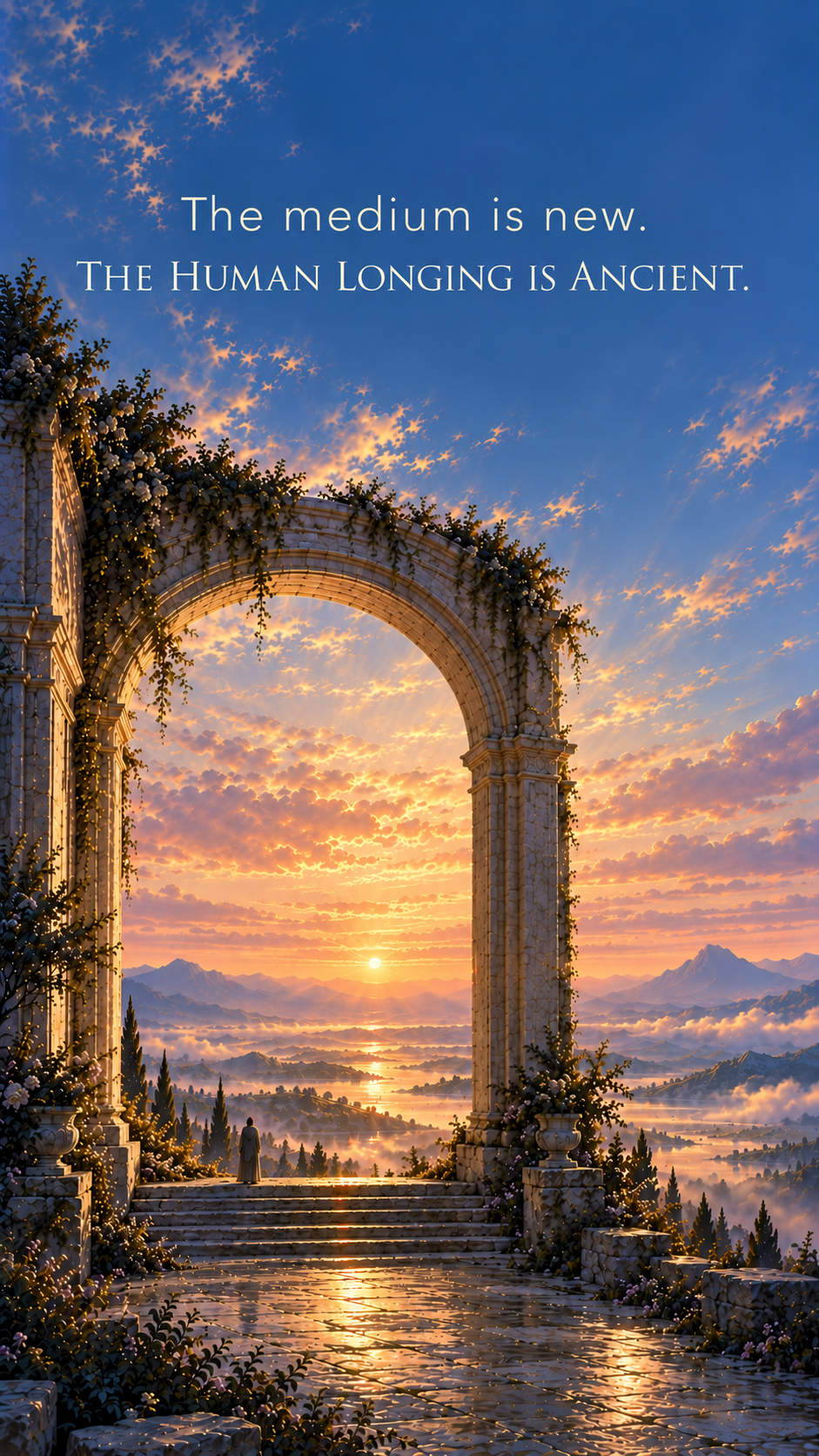
Its website is conceived not merely as a collection of information, but as an online portal to sacred sanctuary: a place where a person may enter intentionally, encounter an image or teaching, sit with a question, undertake a ritual, receive a parable, study a wisdom figure, or simply become quiet enough to behold what is present.
The medium is new. The human longing is ancient.
A sanctuary no longer requires that every seeker cross an ocean, climb a mountain, or enter a particular building. A person sitting alone before a screen may still encounter words, images, practices, and human creations that open an experience of contemplation, renewal, compassion, or awe.
Whether one understands such an encounter as psychological, symbolic, spiritual, or divine remains part of the mystery of the person who enters.
The Dawns makes room for the possibility that the sacred can meet us here, too.
Technology need not only accelerate life.
It can also create a doorway into stillness.
And beyond the doorway remain the ancient realities:
Truth.
Beauty.
Compassion.
Wisdom.
Renewal.
Belonging.
Mystery.
The architecture changes.
The Dawn does not.