
 Image 1 of 1
Real-World Design • Practical Problem-Solving • Critical Thinking
Hands-On • Student-Centered
DESIGN • BUILD • THINK • EXPLAIN
ELA + World History / Social Studies + Architecture Project
What makes something a sanctuary? It’s a deceptively simple question. This lesson turns it into a rigorous exploration of human needs, purposeful design, and the relationship between space and meaning.
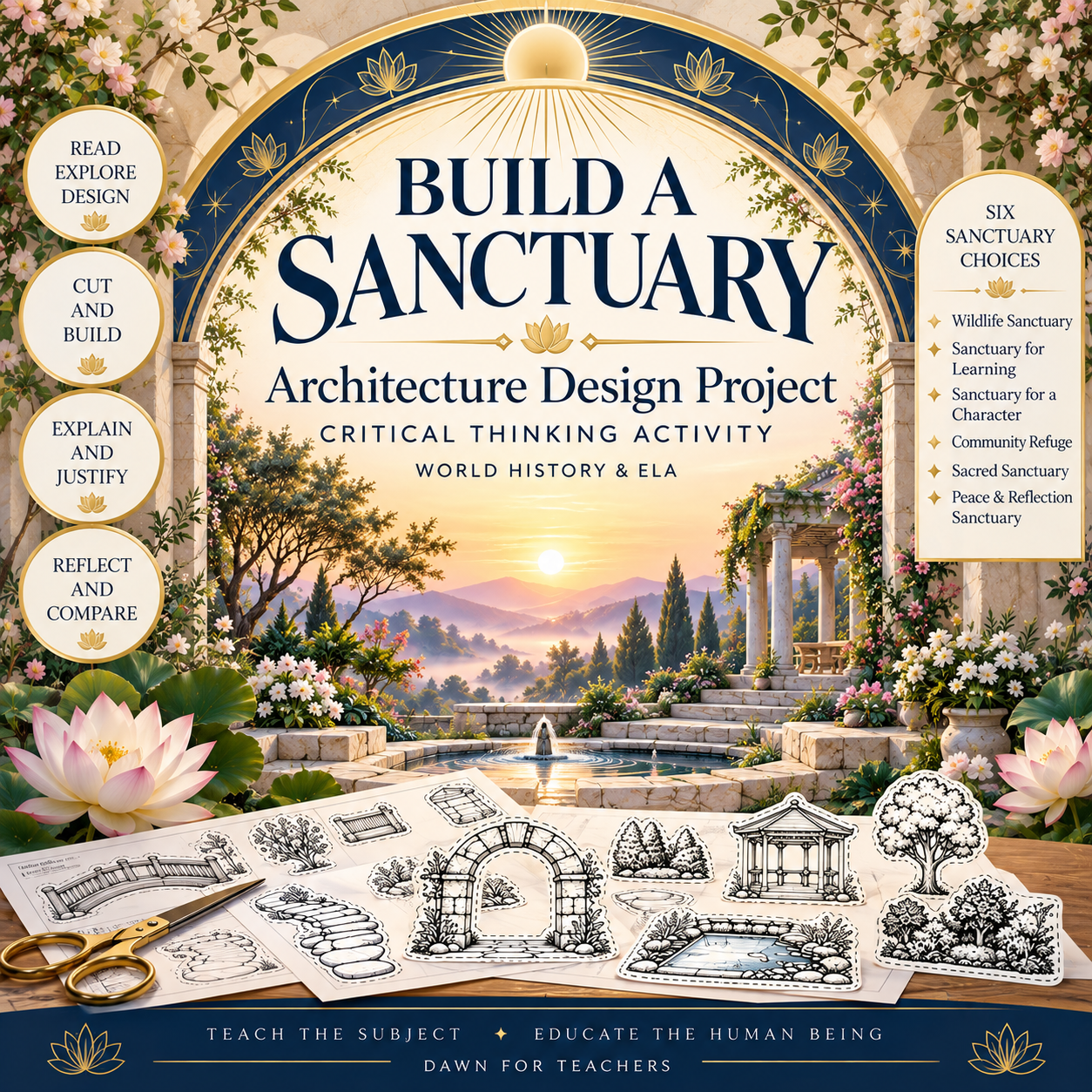
In this interdisciplinary Build a Sanctuary Project, students explore the idea of sanctuary through history, architecture, critical thinking, and writing.
Students begin with a short lesson featuring Guan Yin and Puji Temple as a historical and cultural case study. They then take on the role of architects, using printable cutouts to plan and build an original sanctuary designed around purpose and need. (Everything included. No outside study required of teacher or students.)
This is more than a cut-and-paste activity. Students (individual, pairs, or groups) must make intentional design decisions, test their ideas, and explain the reasoning behind their choices.
What's Included
Teacher Guide: Learning goals, essential question, differentiation, extensions, EL
Bell Ringer
Student Reading: What Makes a Place a Sanctuary?
Guan Yin & Puji Temple Case Study
Build a Sanctuary Design Project. Six distinct design challenges create variety across the classroom while allowing for student choice or teacher assignment.
3 Architectural Cutout Sheets
Architect's Explanation
Teacher chooses Gallery Walk, Student Discussion, or Presentation
Optional Explanatory / Reflective Writing Assessment or Practice
Step-by-Step with sentence frames Writing Outline or prompt & rubric for advanced students
Students Will
examine how spaces can respond to human, community, environmental, or other needs
translate abstract ideas into concrete design choices; experiment with spatial organization
explain and justify their decisions.
The project supports critical thinking, explanatory writing, design thinking, spatial reasoning, reflection, and discussion while leaving room for student agency, creativity and interpretation.
Grades: 7–11
Subjects: World History / Social Studies, ELA: Designing Sanctuary for Characters
Time: Flexible 2–5 class periods
Grouping: Individual, partners, and small groups
Prep: Print the materials and provide scissors, glue, and 11 × 17 construction paper for the sanctuary designs. No student computer work required. Students complete the core lesson entirely offline through discussion, analysis, planning, and hands-on design. Computers are optional for typing the final assessment or completing extension activities.
Real-World Design • Practical Problem-Solving • Critical Thinking
Hands-On • Student-Centered
DESIGN • BUILD • THINK • EXPLAIN
ELA + World History / Social Studies + Architecture Project
What makes something a sanctuary? It’s a deceptively simple question. This lesson turns it into a rigorous exploration of human needs, purposeful design, and the relationship between space and meaning.
In this interdisciplinary Build a Sanctuary Project, students explore the idea of sanctuary through history, architecture, critical thinking, and writing.
Students begin with a short lesson featuring Guan Yin and Puji Temple as a historical and cultural case study. They then take on the role of architects, using printable cutouts to plan and build an original sanctuary designed around purpose and need. (Everything included. No outside study required of teacher or students.)
This is more than a cut-and-paste activity. Students (individual, pairs, or groups) must make intentional design decisions, test their ideas, and explain the reasoning behind their choices.
What's Included
Teacher Guide: Learning goals, essential question, differentiation, extensions, EL
Bell Ringer
Student Reading: What Makes a Place a Sanctuary?
Guan Yin & Puji Temple Case Study
Build a Sanctuary Design Project. Six distinct design challenges create variety across the classroom while allowing for student choice or teacher assignment.
3 Architectural Cutout Sheets
Architect's Explanation
Teacher chooses Gallery Walk, Student Discussion, or Presentation
Optional Explanatory / Reflective Writing Assessment or Practice
Step-by-Step with sentence frames Writing Outline or prompt & rubric for advanced students
Students Will
examine how spaces can respond to human, community, environmental, or other needs
translate abstract ideas into concrete design choices; experiment with spatial organization
explain and justify their decisions.
The project supports critical thinking, explanatory writing, design thinking, spatial reasoning, reflection, and discussion while leaving room for student agency, creativity and interpretation.
Grades: 7–11
Subjects: World History / Social Studies, ELA: Designing Sanctuary for Characters
Time: Flexible 2–5 class periods
Grouping: Individual, partners, and small groups
Prep: Print the materials and provide scissors, glue, and 11 × 17 construction paper for the sanctuary designs. No student computer work required. Students complete the core lesson entirely offline through discussion, analysis, planning, and hands-on design. Computers are optional for typing the final assessment or completing extension activities.